









Расовые различия в интеллекте. Эволюционный анализ - Ричард Линн
Книгу Расовые различия в интеллекте. Эволюционный анализ - Ричард Линн читаем онлайн бесплатно и без регистрации! Читать онлайн вы можете не только на компьютере, но и на андроид (Android), iPhone и iPad. Наслаждайтесь!
222 0 13:41, 25-05-2019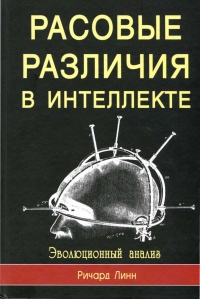
Книга Расовые различия в интеллекте. Эволюционный анализ - Ричард Линн читать онлайн бесплатно без регистрации
Cognizant Communication Corporation.
Geist. V. (1978). Life Strategies, Human Evolution and Environmental Design. New York: Springer-Verlag.
Georgas, J. G., and Georgas, C. (1972). A children’s intelligence test for Greece. In
L. J. Cronbach and P. J. D. Drenth (Eds.). Mental Tests and Cultural Adaptation. The Hague: Mouton.
Georgas, J., Weiss, L. G., van der Vijver, R J., and Saklofske, D. H. (2003). A cross-cultural analysis of the WISC–III. In J. Georgas, L. G. Weiss, R van der Vijver and D. H. Saklofske (Eds.). Culture and Children’s Intelligence. Amsterdam: Academic Press.
Gill. P.. and Byrt, E. (1973). The Standardization of Ravens Progressive A Matrices and the Mill Hill Vocabulary Scale for Irish School Children Aged 6-12 Years. University College, Cork: MA Thesis.
Ginsburg, H. P., Choi, E., Lopez, L. S., Netley, R., and Chao-Yuan, C. (19975 Happy birthday to you: early mathematical thinking of Asian, South American and U. S. children. In T. Nunes and P. Bryant (Eds.). Learning and Teaching Mathematics: An International Perspective. Hove, UK Psychology Press.
Giordani, B., Boivin, M. J., Opel, B., Nseyila, D. N., and Lauer, R. E. (1996). Use of the K-ABC with children in Zaire. International Journal of Disability, Development and Education, 43, 5-24.
Glewwe, P., and Jaccoby, H. (1992). Estimating the Determinants of Cognitive Achievement in Low Income Countries. Washington, D.C.: World Bank.
Globerson, T. (1983). Mental capacity and cognitive functioning: developmental and social class differences. Developmental Psychology, 19, 225–230.
Goa, Y., Qian, M. and Wang, D. (1998). Changes in intelligence over 10 years (in Chinese). Chinese Journal of Clinical Psychology, 6, 185–186.
Gobineau, A. de (1853). essai sur Tinegalite des races humaines. Paris: Didot.
Godman, A. (1964). The attainments and abilities of Hong Kong primary IVpupils: a first study. Hong Kong: Hong Kong University Press.
Goodall, J. (1986). The Chimpanzees of Gombe: Patterns of Behavior. Cambridge, MA: Cambridge University Press.
Goodenough, F. L. (1926a). The Measurement of Intelligence by Drawings. New York: World Books.
Goodenough, F. L. (1926b). Racial differences in the intelligence of school children. Journal of Experimental Psychology, 9, 388–397.
Goodenough, F. L., and Harris, D. B. (1950). Studies in the psychology of children’s drawings: 11, 1928-49. Psychological Bulletin, 27, 396–433.
Goosens, G. (1952а). Etalonnage du Matrix 1947 de J. C. Raven. Revue Beige de Psychologie et de Pedagogie, 14, 74–80.
Goosens, G. (1952b) Une application du test d’intelligence de R.B
Gordon, E. E. (1980). Developmental music aptitudes among inner city primary children.
Bulletin Council for Research in Music Education, 63, 25–30.
Gott, B. (2002). Fire making in Tasmania: absence of evidence is not evidence of absence.
Current Anthropology, 43, 650–655.
Gottfredson, L. S. (1997). Editorial: Mainstream science on intelligence. Intelligence, 24, 13–24.
Gottfredson, L. S. (2005). What if the hereditarian hypothesis is true? Psychology, Public Policy, and Law, 11, 311–319.
Gould, R. A. (1969). Subsistence behaviour among the Western Desert Aborigines of Australia. Oceania, 39, 253–274.
Gould, S. J. (1978). Morton’s ranking of races by cranial capacity. Science, 200, 503–509. Gould, S. J. (1981; 1996). The Mismeasure of Man. New York, Norton. Grantham-McGregor, S, М., and Hawke, W. A. (1971). Developmental assessment of Jamaican infants. Developmental Medicine and Child Neurology, 13, 582–589. Grantham-McGregor, S. М., Powell, C., Walker, S. P., and Himes, J. H. (1991).
Nutritional supplementation, psychosocial stimulation and the mental development of stunted children: the Jamaica study. The Lancet, 338, 1–5.
Grantham-McGregor, S. М., Powell, C., Walker, S. P., Chang, S., and Fletcher, P. (1994). The long-term follow-up of severely malnourished children who participated in an intervention program. Child Development, 65, 428–439.
Grantham-McGregor, S. М., Walker, S. P., and Powell, C. (1994). Methodological approaches used in Kingston, Jamaica, to determine the effect of nutrition and stimulation on child development. In J. B. Stanbury (Ed.). The Damaged Brain of Iodine Deficiency. New York: Cognizant Communication.
Graves, J. L. (2002). An anthropologist looks at race and IQ testing. In J. M. Fish (Ed.).
Race and Intelligence. Mahwah, NJ: Lawrence Erlbaum.
Greenfield, P. M. (1998). The cultural evolution of IQ. In U. Neisser (Ed.). The Rising Curve: Long Term Gains in IQ and Related Matters. Washington, D.C.: American Psychological Association.
Grieve, K. W, and Viljoen, S. (2000). An exploratory study of the use of the Austin maze in South Africa. South African Journal of Psychology, 30, 14–18.
Grigorenko, E. L., and Sternberg, R. J. (2001). Analytical, creative and practical
intelligence as predictors of self-reported adaptive functioning: a case study in Russia. Intelligence, 29, 57–73.
Grine, R E., and Kay, R. R (1988). Early hominid diets from quantitative image analysis of dental microwear. Nature, 333, 765–768.
Groves, C. P. (1991). Genes, genitals and genius: the evolutionary ecology of race. In P. O’Higgins (Ed.). Human Biology: An Integrative Science. Perth, Australia: Center for Human Biology.
Guenole, N., Englert, P., and Taylor, P. J. (2003). Ethnic group differences in cognitive ability test scores within a New Zealand applicant sample. New Zealand Journal of Psychology, 32, 49–54.
Guidon, N., and Delibrias, G. (1986). Carbon-14 dates point to man in the Americas 32,000 years ago. Nature, 321, 769.
Gupta, G. C., and Gupta, S. (1966). Norms for Raven’s Colored Progressive Matrices. Manus, 13, 87–89.
Gupta, S. (1991). Effects of time of day and personality on intelligence test scores.
Personality and Individual Differences, 12, 1227–1231.
Gustafsson, J. E. (1984). A unifying model of the structure of mental abilities. Intelligence, 8, 179–203.
Guthke, J., and Al-Zoubi, А. (1987). Kulturspezifische Differenzen in den Coloured Progressive Matrices (CPM) und in einer Lemtestvariante der CPM. Psychologie in Erziehung und Unterricht, 34, 306–311.
Hadidjaja, P., Bonang, E., Suyardi, A., Abidin, A. N., Ismid, I. S., and Margono, S. S. (1998). The effect of intervention methods on nutritional status and cognitive function of primary school children infected with ascaris lumbri-coides. American Journal of Tropical Medicine, 59, 791–795.



Прочитали книгу? Предлагаем вам поделится своим впечатлением! Ваш отзыв будет полезен читателям, которые еще только собираются познакомиться с произведением.
Уважаемые читатели, слушатели и просто посетители нашей библиотеки! Просим Вас придерживаться определенных правил при комментировании литературных произведений.
Просьба отказаться от дискриминационных высказываний. Мы защищаем право наших читателей свободно выражать свою точку зрения. Вместе с тем мы не терпим агрессии. На сайте запрещено оставлять комментарий, который содержит унизительные высказывания или призывы к насилию по отношению к отдельным лицам или группам людей на основании их расы, этнического происхождения, вероисповедания, недееспособности, пола, возраста, статуса ветерана, касты или сексуальной ориентации. Просьба отказаться от оскорблений, угроз и запугиваний. Просьба отказаться от нецензурной лексики. Просьба вести себя максимально корректно как по отношению к авторам, так и по отношению к другим читателям и их комментариям.
Надеемся на Ваше понимание и благоразумие. С уважением, администратор My-Books.me.
Оставить комментарий

-
 Александра15 январь 09:37
Очень интересная книга! Особенно, если любишь психологию и хочешь понимать себя и других. Обязательно послушаю до конца. Спасибо....
Кригер Борис – Гнев
Александра15 январь 09:37
Очень интересная книга! Особенно, если любишь психологию и хочешь понимать себя и других. Обязательно послушаю до конца. Спасибо....
Кригер Борис – Гнев
-
Галина25 май 13:02
Очень уважаю Артема Шейнина, книга замечательная, очень мне близкая по духу.Перечитываю уже второй раз, столько пережитого и не...
Мне повезло вернуться - Артем Шейнин
-
Екатерина11 январь 08:05
Доброе утро. Подскажите пожалуйста как сохранять книги, ставить закладки?...
Подонок - Анастасия Леманн